
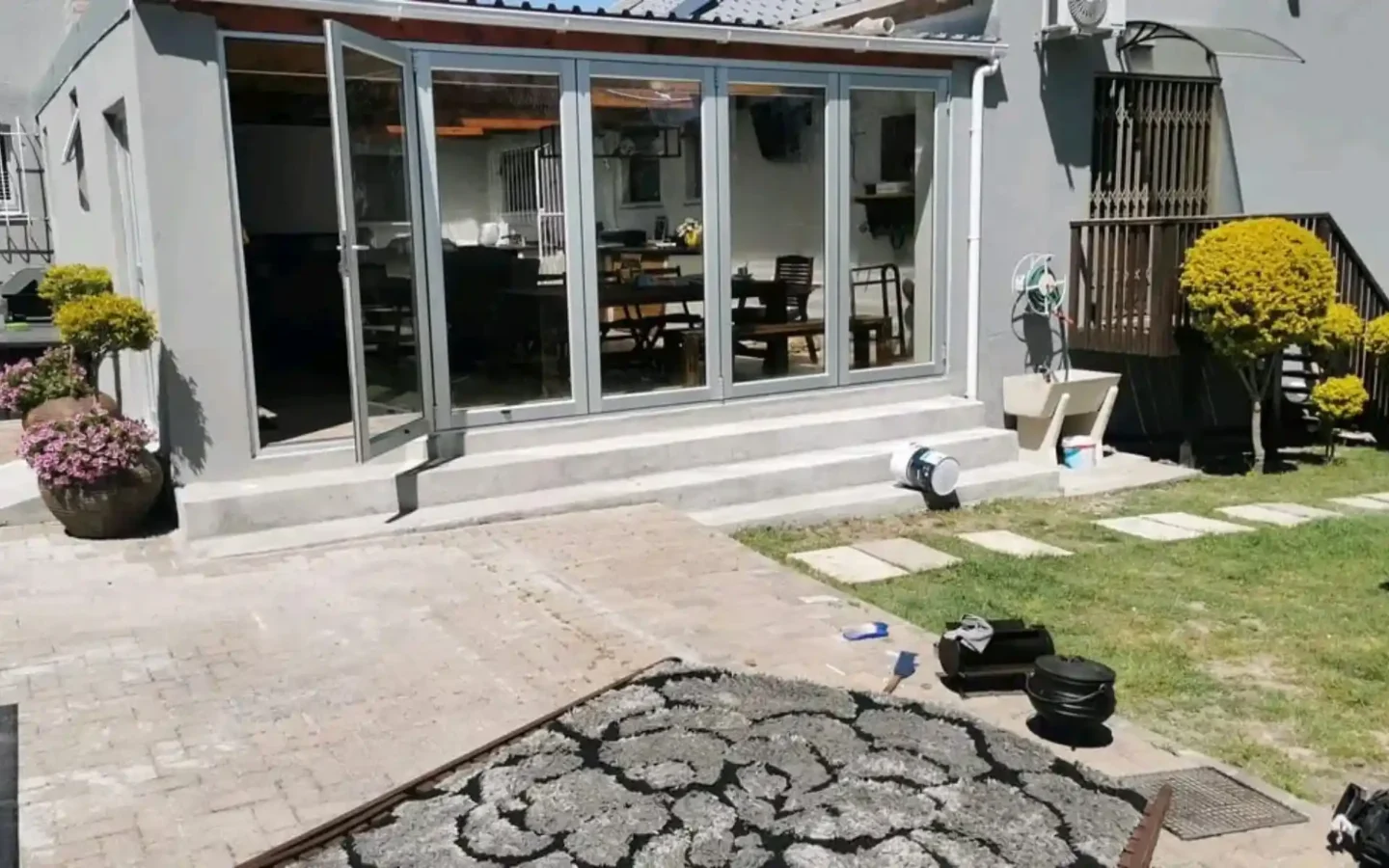
If you are opening up a living area to a patio, pool or garden, you will probably end up choosing between two systems: a sliding door or a sliding folding door. Both are aluminium frames with large panes of glass, and both look good on the day they go in. They behave very differently after that.
How much of the wall opens
A sliding door opens by moving one panel in front of another. With a standard two-panel door, about half the opening clears. A stacking door, where each panel runs in its own track, does better: three panels on three tracks leave two thirds of the opening clear.
A sliding folding door folds its panels together at one or both sides. Fully open, only the folded stack is left, so almost the whole width clears.
If the point of the new door is to join the inside and outside into one space on summer evenings, that difference matters more than anything else in this article.
How you use it day to day
Think about ordinary days, not just the braai with friends. A sliding door opens with one movement of one panel, as often as you like. A folding door that you only want to step through is less convenient, unless one end panel is set up to open on its own as a door. Many folding layouts allow for that, so ask for it when you request a quote.
Space beside the opening
Folded panels have to go somewhere. Each panel adds to the thickness of the stack, so look at what sits beside the opening: a wall return, a window, a pillar or a kitchen counter. Folding panels also swing out as they fold, into the room or onto the patio, so furniture, pot plants and steps nearby need room.
Sliding panels stay in line with the frame. Nothing needs clear floor space, which is why a slider is often the easier fit beside a dining table or on a narrow balcony.
Weather
Cape Town’s winter storms drive rain at doors and windows, and the southeaster pushes sand and dust into tracks in summer. Whichever system you choose, the threshold matters on an exposed wall: a raised sill keeps water out better than a flush one. Folding doors also have more joints between panels, each of which has to seal. Sliders have fewer.
On the Atlantic Seaboard and along the West Coast, salt air adds to this. Our notes on caring for aluminium near the sea cover what to do about it.
Upkeep
Both need their tracks kept clean. A sliding door has rollers and a lock to look after; a folding door adds hinges between every pair of panels. Neither is demanding, but a slider has fewer moving parts.
Cost
Price depends on size, the number of panels, the glass and the frame colour, so there is no single figure to give here. For the same opening, though, a folding set has more panels and more hardware than a sliding door, and that shows in the quote. The fairest comparison is to ask for both on the same opening.
A quick way to decide
- Choose a sliding door if the opening is wide, you mostly look through it, there is little room beside it, or it faces the weather.
- Choose a sliding folding door if you want the whole wall open, there is room for the stack, and the inside and outside are used together.
Still unsure? Many openings can take either, and when we measure we can price both so you can compare like with like. Read more about aluminium sliding doors and sliding folding doors, or request a quote.